General Solid Rocket Motor Design Process
Rocket motors can be divided into two broad categories: liquid fuel and solid fuel. There is a third category called hybrid that is a compromise between the two. They usually have a solid fuel grain and liquid oxidizer. This article will focus on the solid type and the general design process for creating one.
What characterizes a solid rocket motor and why are they useful? Solid rocket propellant usually consists of a discrete phase oxidizer (ammonium perchlorate, or sometimes ammonium nitrate) mixed into a continuous phase fuel (usually hydroxyl terminated polybutadiene or HTPB), along with other ingredients. After incorporation, the HTPB is cross linked with an isocyanate, poured into a rocket motor case, cartridge or mold and cured to form a rubber-like material that contains both fuel and oxidizer.
The main advantage of a solid rocket motor is that it is instantly ready for use. Liquid fuel engines must typically be fueled immediately before launch. Their oxidizers tend to be cryogenic (liquid oxygen), or highly corrosive liquids, requiring special handling equipment and lots of time. Missiles that must be immediately available for launch from remote field locations, like artillery rockets, antiaircraft or submarine-launched missiles need solid fuel motors.
The design process for solid motors requires selection of the propellant, configuration of the grain geometry, sizing the nozzle throat diameter, designing the pressure vessel (motor case), insulating it from the hot gases, nozzle and igniter design, designing the manufacturing process and testing, among other steps. It is an iterative process requiring many input parameters, some of which are not well characterized (like heat transfer coefficients, insulator material properties, resonance characteristics to name a few.
The design process starts with the motor requirements. These come in three forms: build-to-print, interior ballistic, and exterior ballistic. Build to print motors have already been designed by someone else, and I will ignore that category for now.
Motor requirements can be given in terms of missile exterior ballistic requirements. These requirements describe the desired ballistic trajectory of the missile. Exterior ballistic requirements include space constraints, payload weight and desired altitude, range, acceleration, peak velocity, spin, etc. In this approach, the designer creates a concept motor and conducts interior ballistic analysis to extract a thrust/time curve. The curve is then imported into an exterior ballistic analysis program to predict the trajectory. If requirements are not met, the motor design is iterated until they are.
Often the missile prime customer has already conducted the exterior ballistic analysis and defined the interior ballistic requirements that are handed off to the motor designer. Interior ballistic requirements include space claim allotment, motor weight, thrust versus time curves, total impulse, burn time (action time), thrust rise time, blowdown, and other motor performance characteristics. This is analogous to setting car engine requirements based on horsepower, torque, weight, and motor compartment/fuel tank size limitations.
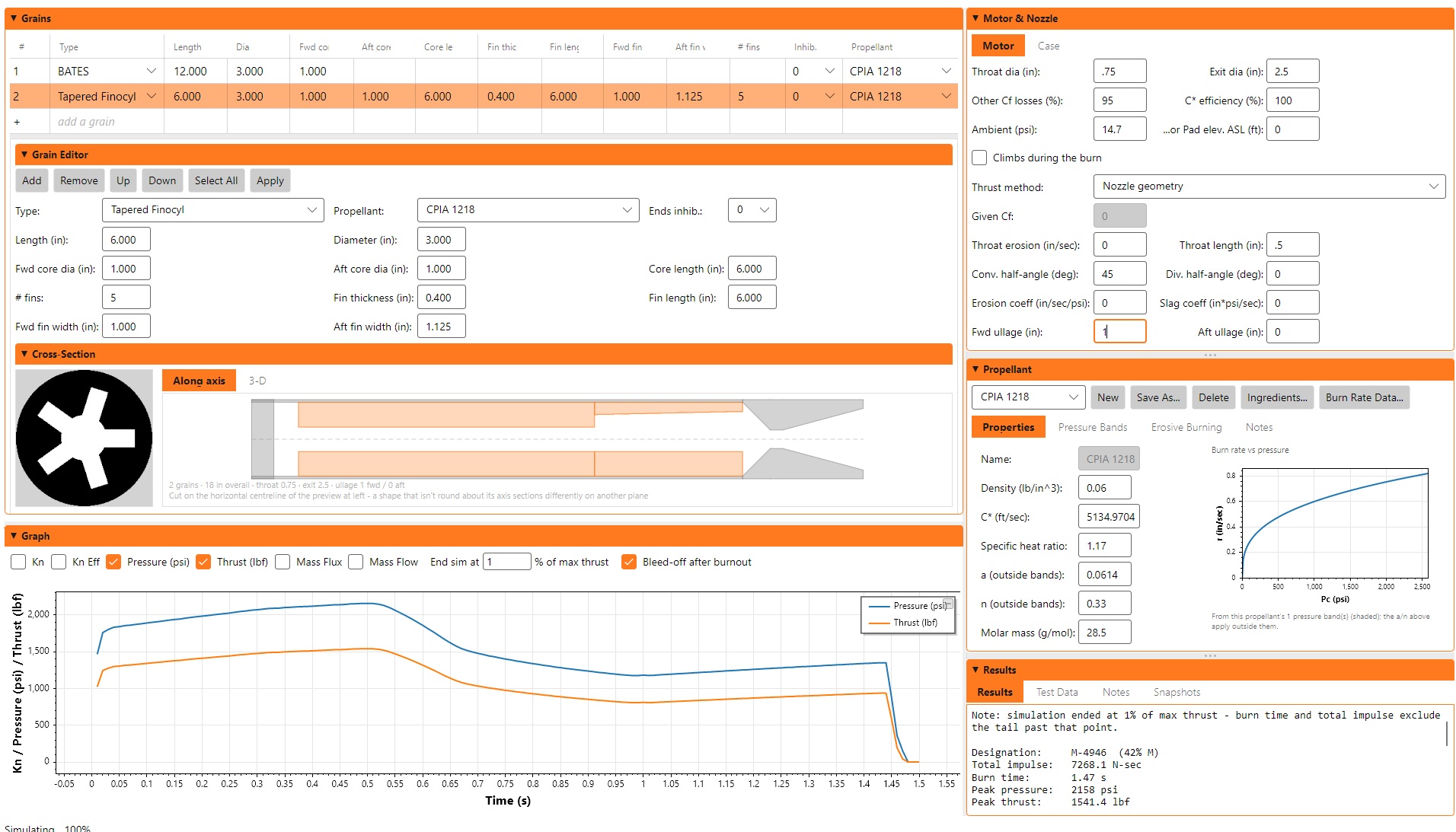
Whatever the approach, rocket motor design is an iterative process. The motor designer will notionally select a propellant formulation, grain geometry, nozzle throat diameter, motor case thickness, and insulation thickness based on experience or assumptions. He will generate a thrust/time curve using an interior ballistic program. He will then compare interior ballistic predictions to requirements or alternatively import the thrust/time curve into an exterior ballistic program to predict missile range. If the design does not meet requirements, he will attempt to improve it and then run the analysis again.
Once the designer has a baseline design that meets requirements, he will subject the design to heat transfer and structural analysis. These will return required motor case wall and insulation thicknesses. The ballistician will then adjust grain diameter assumptions in the ballistic model, rerun it, and generate updated ballistic predictions. This process is repeated until either requirements are met, or a determination is reached that they cannot be met.
So far, we have only generated analytical predictions. These will conform to reality in varying degrees, depending on a variety of factors. The design must be verified before full scale implementation as motor hardware components and system testing are very time-consuming and expensive.
A flow chart indicating my motor design process is shown below. This is meant as a general guideline as no two motor designs proceed exactly alike. Different organizations take different approaches to the effort. larger organizations may have entire departments responsible for some of the functions. Smaller ones may have only one person for each of the major functions (or even less). Subsequent articles will examine the individual design elements in detail, outlining common issues and approaches.
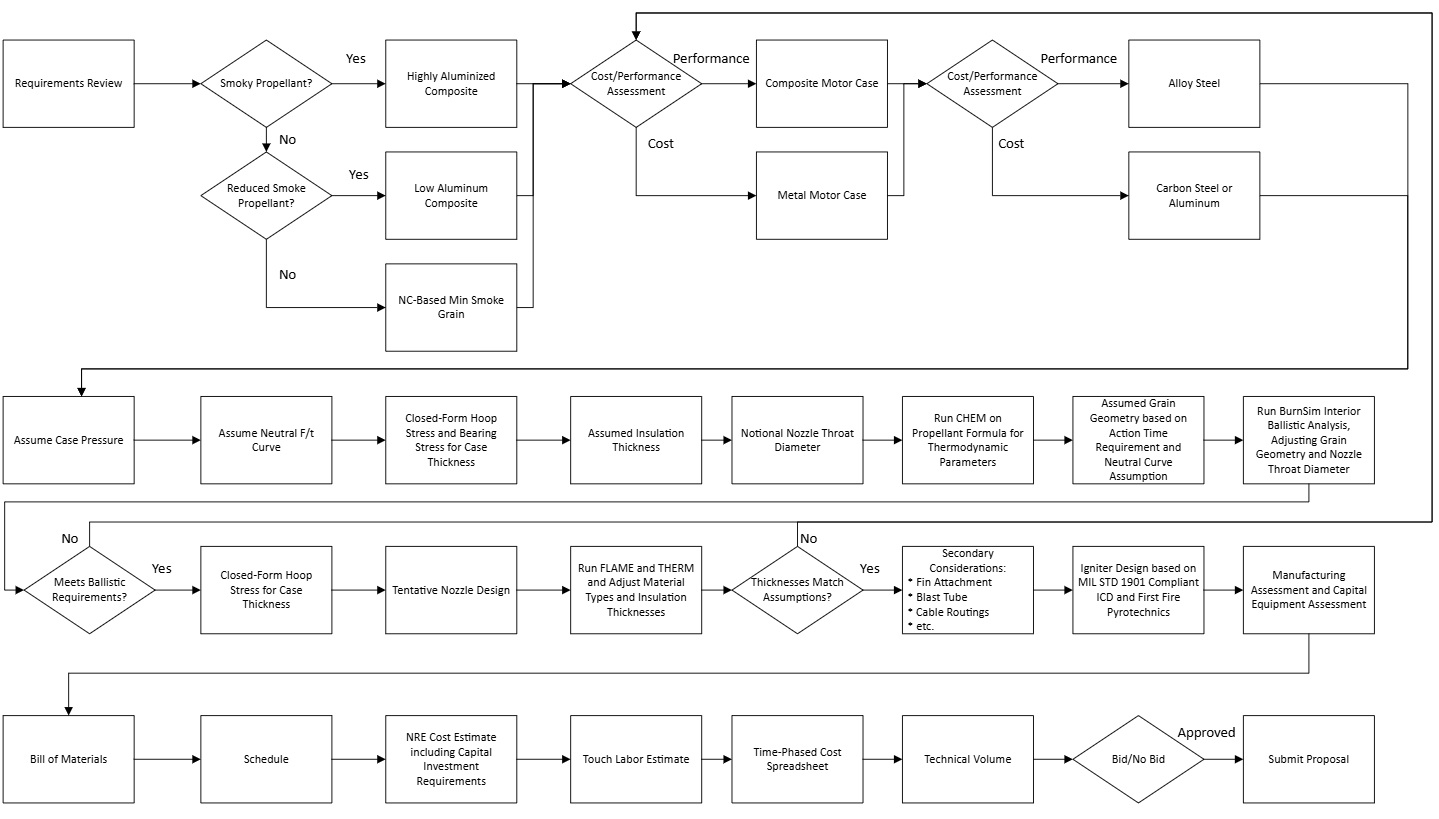
An interesting subset of rocket motor design is the competitive proposal process. This often requires generating a technical volume that proposes a viable design concept. The concept is not a complete design, but it must be close enough so that the prospective customer can assess technical feasibility and an accurate cost and schedule estimate can be determined. Each design step still applies, with some of them closed by analogy to similar designs or engineering judgement instead of analysis or testing.
Privacy Policy
Web site and all contents Copyright Explosives Consulting LLC. All rights reserved.


